Badminton Tutorial Program · Basic
The Serve
Badminton serves are struck upward from below — there are no free aces here, only a well-placed start that denies your opponent the attack. Modern club play revolves around the low backhand serve; the high serve remains a legitimate singles weapon that pushes your opponent to the back fence.
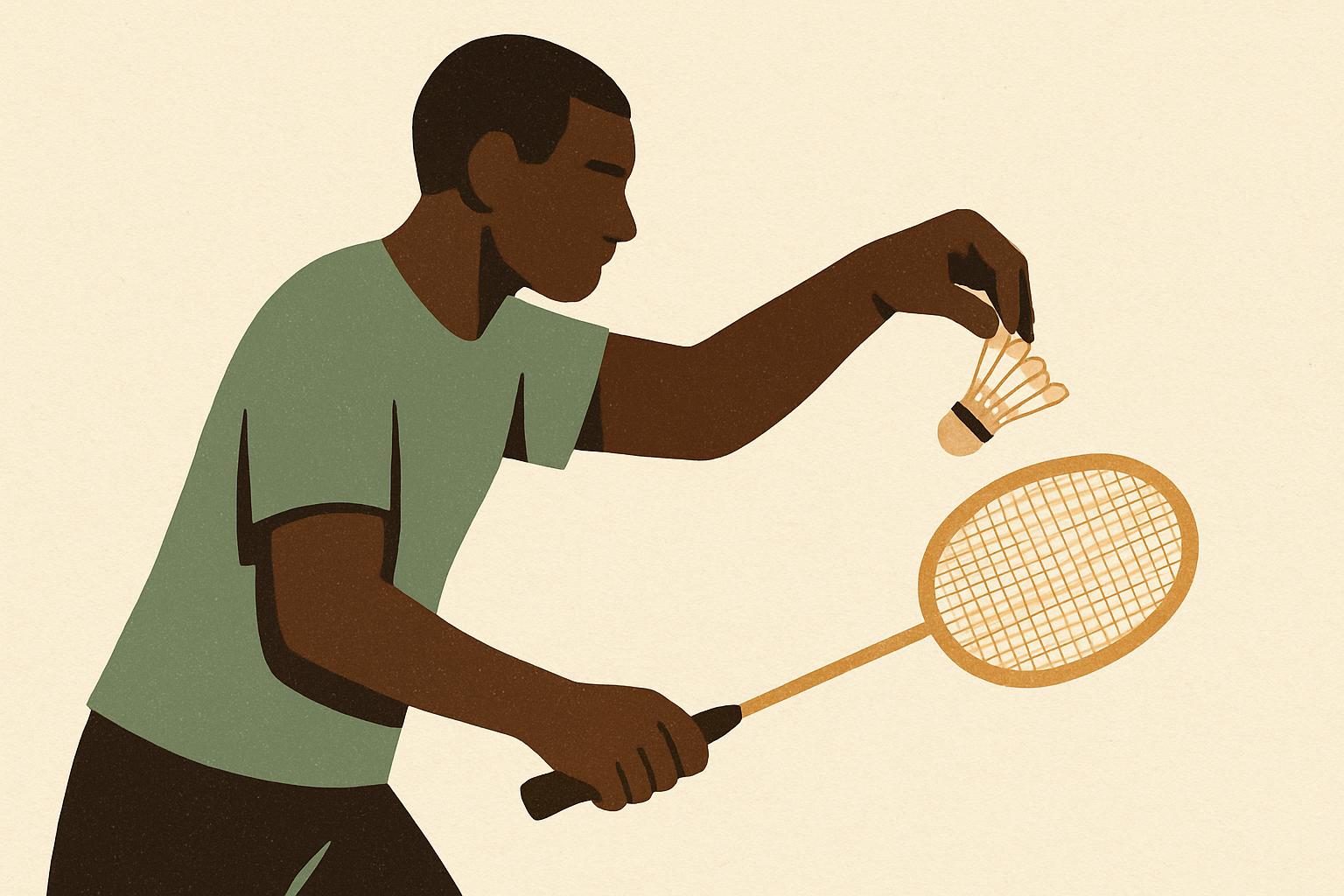
One thing to master: the LOW BACKHAND SERVE, skimming the tape and landing on the front service line. It's the serve you'll use in ninety percent of club games.
What you'll learn
- Service legality: below the waist / the 1.15m rule, upward strike, feet grounded
- The low backhand serve — grip, stance, and the skim over the tape
- The high forehand serve for singles
- Where to aim and why the T dominates
The technique
Know the laws
At contact the whole shuttle must be below the server's waist (defined as the lowest rib) and the racket shaft must point downward — at BWF-instrumented events this is replaced by a fixed 1.15m contact height. Both feet must stay in contact with the floor, the strike must be one continuous motion, and the shuttle must land in the diagonal service box. The receiver must be ready — but if they attempt a return, they were ready.
The low backhand serve
Stand a foot behind the front service line near the T, racket foot forward. Hold the shuttle by the feathers in front of your chest, thumb grip on a shortened handle. Push — don't hit — the shuttle off the cork with a gentle thumb press, aiming to SKIM the tape and die on the opponent's front service line. Same routine, same rhythm, every time.
The high serve (singles)
From a forehand grip, drop the shuttle and swing under it with a full relaxed arm, sending it HIGH and DEEP so it falls vertically on the back line. A good high serve neutralises attackers who crowd the T — but in doubles it invites the smash, which is why it lives mainly in singles.
Placement beats variety
Serve to the T (centre) as your default — it shortens the receiver's angles. Mix in the wide serve and an occasional flick (a disguised quick serve over the receiver's racket) only often enough to keep them honest.
Drills to practice
- Serve 20 low serves at a shuttle tube laid on the opponent's front service line — count hits
- Tape target: a string 20cm above the net; serves must pass between tape and string
- Pressure sets: 5 consecutive legal low serves before ending practice; restart on a fault
Common mistakes
- Contact above the waist or with an upward-pointing shaft — the most common club-level service fault
- Hitting the low serve instead of pushing it (it balloons attackably high)
- Telegraphing the flick serve by changing your stance or rhythm
References
- BWF Statutes, Section 4.1 — Laws of Badminton, Law 9 (Service) — including the fixed-height service alternative — system.bwfbadminton.com/documents/folder_1_81/Statutes/CHAPT
- BWF Shuttle Time — official BWF teaching programme (technique modules) — shuttletime.bwfbadminton.com/
Rule statements in this lesson were validated against the BWF Laws of Badminton (Statutes Section 4.1, current edition) and BWF announcements. Technique and drill guidance follows the BWF Shuttle Time framework and widely taught club coaching practice.