Badminton Tutorial Program · Advanced
Doubles Strategy & Rotation
Doubles is badminton's team sport within the sport, and it runs on one beautiful engine: the rotation. Attacking pairs stack front-and-back to keep hitting down; defending pairs spread side-by-side to cover the smash. Every lift flips the geometry — and pairs that flip smoothly beat stronger hitters who don't, every single club night.
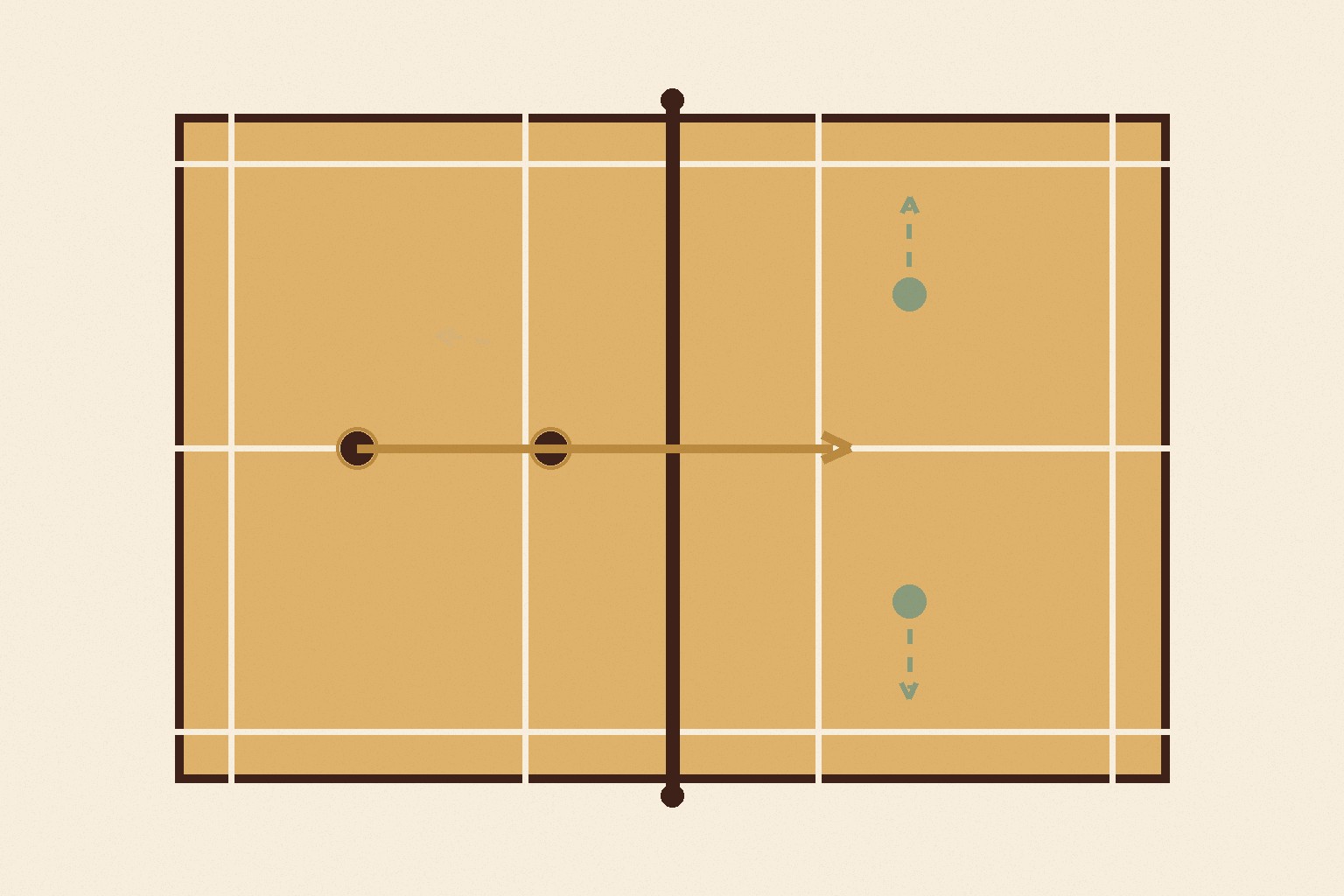
One thing to master: the rotation rule. Attacking = front-and-back; defending = side-by-side; the moment your side lifts, split sideways — the moment they lift, take the front and back.
What you'll learn
- The two formations and the single rule that switches them
- Rotation mechanics: who goes front, who covers back, without discussion
- Serve and return roles — the four shots that decide most doubles rallies
- Communication and the middle ball
The technique
The engine rule
Your side hits DOWN or plays tight to the net → attack: one player at the front (racket up, hunting), one covering the rear. Your side LIFTS or clears → defence: split side-by-side, thumb grips, low stance. The transition happens DURING the shuttle's flight, not after — watch good pairs and the formation change is finished before the opponent hits.
Who goes where
Natural rotation: whoever plays a downward shot from midcourt FOLLOWS it forward; their partner slides back to cover. Whoever lifts from the front retreats to a side as their partner joins the defensive line. No negotiation mid-rally — the SHOT decides the shape, and both players read the same shot.
The first four shots
Doubles rallies are usually decided by serve, return, third, and fourth. Server: low serve to the T, racket instantly up for the reply. Receiver: crowd the service line and attack anything loose — push to the gaps or drive at the server's partner. Third shot: the server's side must avoid lifting; fourth: the receiving side punishes if they do. Drill these four in isolation — they are a quarter of every game.
Talk and the middle
'Mine / yours / out / switch' — early and loud. The middle ball between two defenders belongs, by default, to the player on the FOREHAND side... unless a call says otherwise, and the call always wins. Silent pairs donate the middle; talking pairs own it.
The advanced doubles mindset
Keep the shuttle DOWN even at the cost of pace; serve and return like the rally depends on it (it usually does); rotate on the shot, not on the outcome; and treat every lift you're forced into as a debt to repay with the very next block or drive.
Drills to practice
- Formation flips: coach alternates feeding lifts and drops to your pair — call and complete each rotation before playing the shot
- First-four-shots games: rallies end after shot four; score only within those shots; rotate servers every five points
- Front-court hunter drill: front player must touch every reply above tape height for 10 rallies while the back player covers everything else
Common mistakes
- Both players drifting into side-by-side while attacking (the smash gap opens instantly)
- The front player turning to WATCH their partner's smash instead of hunting the block
- Serving loose and high in doubles — it's the fastest way to start every rally defending
References
- BWF Statutes, Section 4.1 — Laws of Badminton, Law 9 (Service) and Law 12 (Doubles service-court errors) — system.bwfbadminton.com/documents/folder_1_81/Statutes/CHAPT
- BWF Shuttle Time — official BWF teaching programme (technique modules) — shuttletime.bwfbadminton.com/
Rule statements in this lesson were validated against the BWF Laws of Badminton (Statutes Section 4.1, current edition) and BWF announcements. Technique and drill guidance follows the BWF Shuttle Time framework and widely taught club coaching practice.