Badminton Tutorial Program · Basic
Introduction to Badminton
Badminton is the fastest racket sport on earth — smashes leave elite rackets at over 400 km/h — yet it's also one of the friendliest to start: rallies happen on day one, and the shuttle's dramatic deceleration keeps them playable. It's an indoor sport of speed, touch, and lungs, and it rewards technique over strength more than almost any other game.
You only need ONE thing from this lesson: understand the shuttle. It never bounces, it decelerates violently, and everything in badminton follows from those two facts.
What you'll learn
- The court: 13.4m long, doubles 6.1m wide, singles narrower — and why the lines matter
- The shuttle: feather vs nylon, why it never bounces and how it flies
- Racket and grip size basics — what a beginner actually needs
- The shape of a rally: from serve to finish
The technique
The court
A badminton court is 13.40m long. Doubles uses the full 6.10m width; singles uses the narrower inner side lines. The net stands 1.55m at the posts, dipping to 1.524m at the centre. Front service line, centre line, and the doubles' long-service line divide the court into the service boxes you'll learn in Lesson 2.
The shuttle
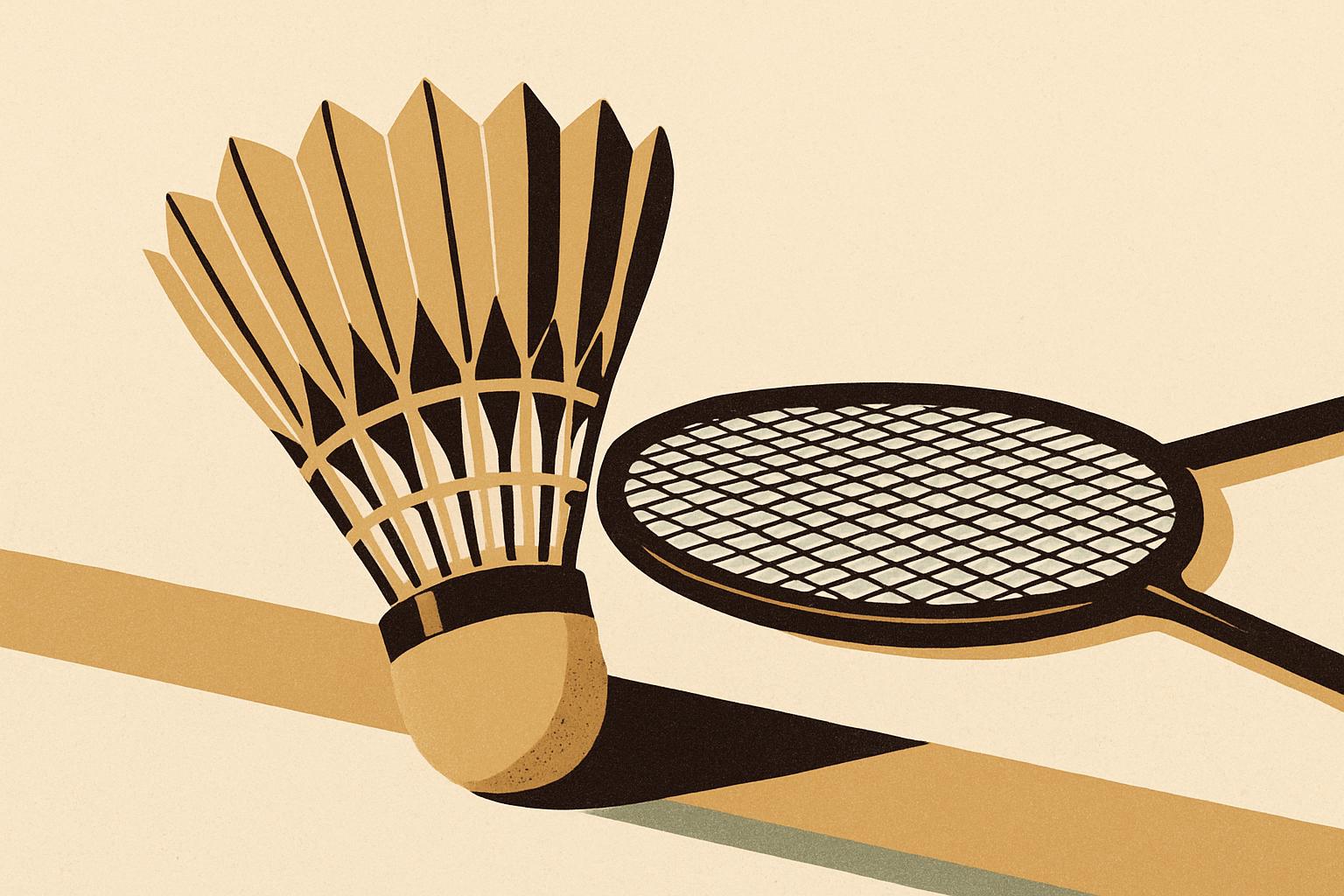
Sixteen overlapping feathers (or a nylon skirt) around a cork base. It leaves the racket fast and then brakes hard — a shuttle can leave at 300+ km/h and cross the net at a tenth of that. There is NO bounce: every ball is taken out of the air, which is why footwork (Lesson 5) matters more here than in any tennis-family sport.
The racket
Light (80–95g), head-light rackets are more forgiving for beginners; balance and string tension matter far more than price. Any mid-range racket strung around 20–24 lbs is plenty until your technique outgrows it.
What a rally looks like
Serve, then a fight for the ATTACK: shots that force your opponent to hit UPWARD hand you the smash. Watch a club game and notice — the player hitting down is almost always the one winning the rally.
Drills to practice
- Rally cooperatively 20 times over the net, any stroke — calibrate how the shuttle dies in the air
- Throw a shuttle as far as you can — feel how fast it stops; that deceleration is the sport's physics in one throw
- Watch one good doubles game and count how many rallies end with a downward shot
Common mistakes
- Buying a stiff, head-heavy 'smash' racket as a beginner — it punishes every off-centre hit
- Expecting tennis-style bounces and waiting for the shuttle instead of moving to it
- Playing in running shoes — badminton is lateral lunges; court shoes protect your ankles and knees
References
- BWF Statutes, Section 4.1 — Laws of Badminton, Law 1 (Court and Court Equipment) and Law 2 (Shuttle) — system.bwfbadminton.com/documents/folder_1_81/Statutes/CHAPT
- BWF Shuttle Time — official BWF teaching programme (technique modules) — shuttletime.bwfbadminton.com/
Rule statements in this lesson were validated against the BWF Laws of Badminton (Statutes Section 4.1, current edition) and BWF announcements. Technique and drill guidance follows the BWF Shuttle Time framework and widely taught club coaching practice.