Badminton Tutorial Program · Basic
Rules & Scoring
Badminton's rules are compact: every rally scores a point, games run to 21, and the server's position is dictated entirely by their score. Learn the service-court logic and the short list of faults and you can play — and referee — any club game with confidence.
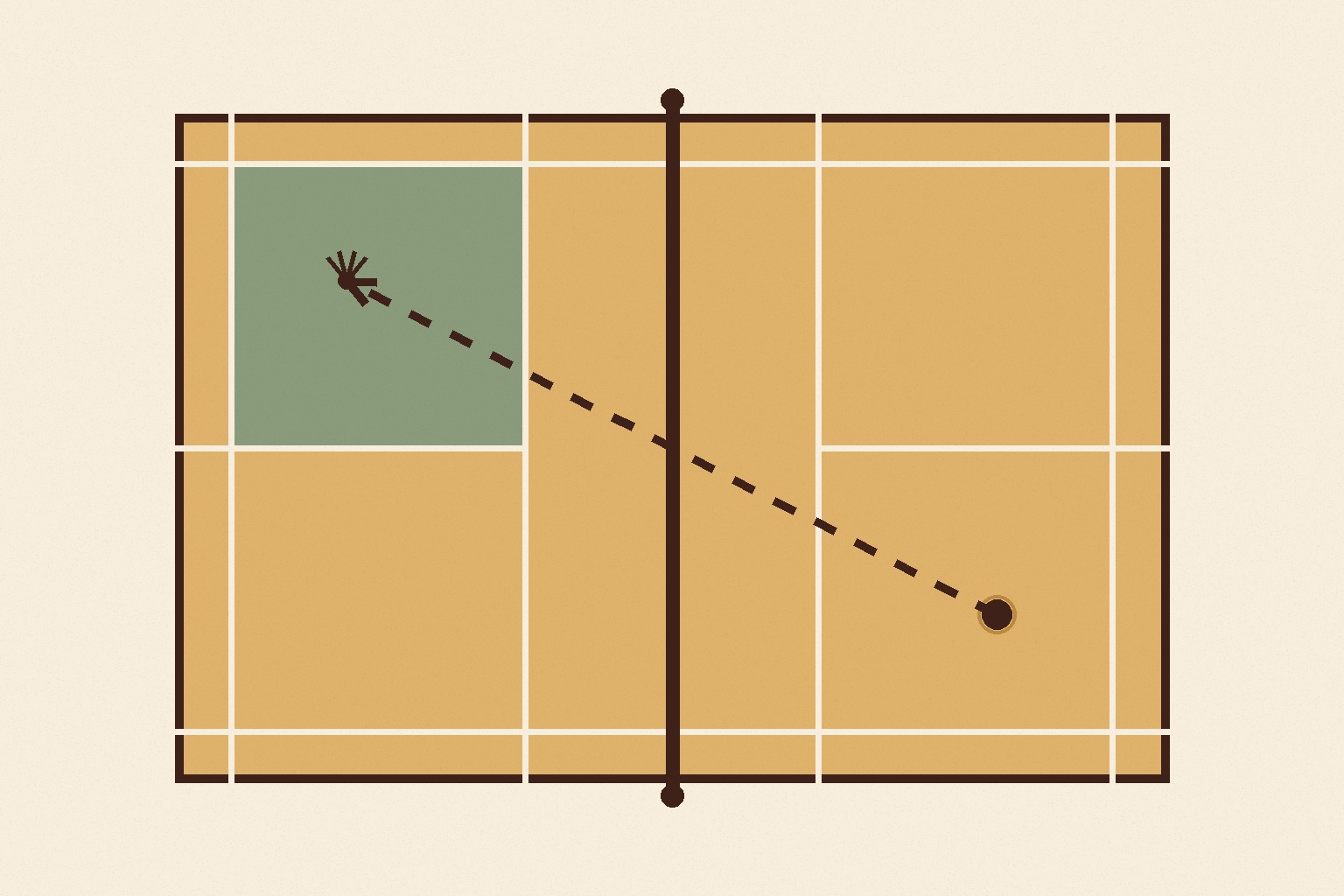
One thing to master: even score → serve from the RIGHT court; odd score → serve from the LEFT. Say your score before serving and the court chooses itself.
What you'll learn
- Rally scoring: 21 points, win by 2, capped at 30 (29-all: next point wins)
- Service courts: even score serves from the right, odd from the left
- Doubles service rotation — who serves, from where, after which rallies
- The common faults: service faults, net touches, double hits, and the shuttle landing out
- Heads-up: BWF's 3×15 scoring system arrives 4 January 2027
- Traditional and club scoring you'll still meet: side-out to 15, single games to 21 or 31
The technique
Rally scoring
Every rally wins a point regardless of who served. Games go to 21; you must lead by 2, and at 29-all the 30th point wins outright. Matches are best of three games. A 60-second interval comes when the leading score reaches 11, and 120 seconds between games.
The service-court logic
One rule covers everything: if the SERVER's score is EVEN, they serve from the RIGHT service court; ODD, from the LEFT — diagonally into the opposite box. In doubles, the receiving side never rotates on its own: you keep your court until your side wins a rally WHILE serving, which is when the server alternates boxes.
Faults that end a rally
Shuttle lands outside the lines (the line itself is IN); shuttle fails to cross the net or passes under it; you touch the net or posts with racket or body during play; the shuttle is hit twice by the same side; you reach OVER the net to hit it (following through across is fine after contact on your side).
Scoring is changing in 2027
BWF has approved the 3×15 system effective 4 January 2027: games to 15 points, win by 2 at 14-all, capped at 21 (20-all: next point wins), interval when the leading score reaches 8. Everything else — rally scoring, service-court logic — stays the same, so what you learn here transfers unchanged.
Traditional & club scoring you'll still meet
Before 2006, official badminton used SERVICE ('side-out') scoring: only the serving side could score, men's singles and all doubles played to 15 (women's singles to 11), doubles sides had two serves, and tied late games could be 'set' (extended). Veterans' clubs and some communities still play it — if only the server scores, you're in the traditional system. Separately, social clubs often run their own formats to keep courts rotating: a single game to 21, or one long game to 31 (common in Philippine club nights). House scoring changes the arithmetic, never the laws — serves, faults, and court logic stay exactly as in this lesson.
Drills to practice
- Play one game where your only goal is to call your score AND serve from the correct court every time
- Referee a friendly doubles game for one match — service-court errors are where you'll learn the rotation
- Quiz pairs: one player states a situation ('my follow-through crossed the net'), partner rules fault or legal
Common mistakes
- Serving from the wrong court after losing track of the score (call it out loud — it solves itself)
- Believing the line is out (it's in, on every line that bounds the court in play)
- Touching the net on a rushed net kill — a fault even if the shuttle was already dead-weight over the tape
References
- BWF Statutes, Section 4.1 — Laws of Badminton, Law 7 (Scoring System), Law 9 (Service), Law 13 (Faults) — system.bwfbadminton.com/documents/folder_1_81/Statutes/CHAPT
- BWF — Key Changes Under the 3×15 Scoring System (effective 4 January 2027) — bwfbadminton.com/news-single/2026/04/26/key-changes-under-th
- World Badminton — Laws of Badminton archive (including the pre-2006 traditional service-scoring laws) — www.worldbadminton.com/rules/
- BWF Statutes hub (laws & regulations, kept current) — corporate.bwfbadminton.com/statutes/
Rule statements in this lesson were validated against the BWF Laws of Badminton (Statutes Section 4.1, current edition) and BWF announcements. Technique and drill guidance follows the BWF Shuttle Time framework and widely taught club coaching practice.