Badminton Tutorial Program · Advanced
Advanced Footwork & Recovery
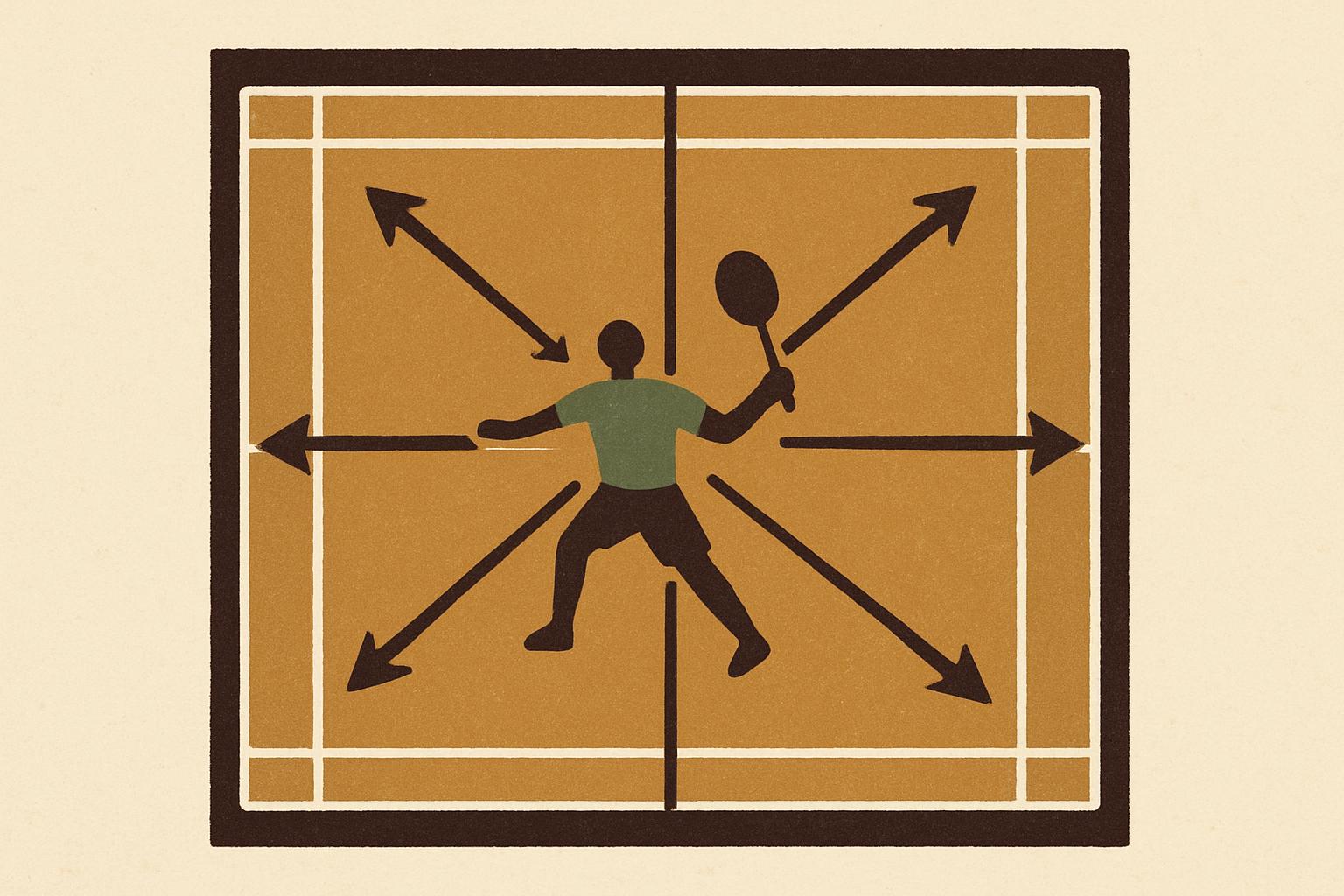
Basic footwork gets you to the shuttle; advanced footwork gets you there EARLY, with balance to spare, rally after rally. The upgrades are precise: corner-specific patterns, controlled jumps, and — the real separator — an intelligent base that shifts with every shot you play.
One thing to master: recovery BIAS. Don't return to dead centre — shade your base toward the reply your own shot just made most likely.
What you'll learn
- Corner patterns: the exact step sequences to all six corners and back
- The China jump and scissor kick for attacking the rear court
- Recovery bias: positioning by probability, not geometry
- Rhythm and economy: fewer, bigger, earlier steps
The technique
The six corners
Front corners: split, one chasse, lunge. Mid sides: split and push directly into a wide lunge. Rear forehand: split, turn, chasse, jump or stride behind the shuttle. Rear backhand: round-the-head footwork (Lesson 12) or the turn-and-go. Drill each as a fixed pattern until the sequence is subconscious and only the DECISION remains.
Attacking jumps
The scissor kick — legs exchanging mid-air as you strike overhead in the rear court — lets you hit and land already moving forward. The China jump — a two-footed lateral leap to intercept lifts early at the sides — steals half a second from the defence. Both are earned: master grounded overheads first, land soft, knees over toes.
Recovery bias
After a tight cross-court net shot, the straight net reply is most likely — recover NEAR the net, biased straight. After a deep clear, shade back a half-step. After a wide smash, expect the block to the open front corner. Dead-centre base is for players who don't know what they just hit; probability base is for players who do.
Economy
Advanced movement often means FEWER steps: earlier split-steps, bigger first pushes, and arriving with one balanced lunge instead of three panicked stutters. Film yourself: count steps to each corner, then cut one.
Drills to practice
- Shadow sequences: coach (or app timer) calls corners at random for 45-second sets — full pattern to each, recovery to a CALLED base bias
- Scissor-kick clears: 15 rear-court feeds, each struck with the scissor kick and landing into a forward recovery step
- Bias games: after every shot you must verbally call your recovery bias ('straight net!') — partner tries to hit where you didn't call
Common mistakes
- Recovering to geometric centre after every shot regardless of what you hit
- Jumping before the basics — an unbalanced jump smash is worse than a grounded one
- Stutter-stepping: many tiny steps where one committed push would arrive earlier
References
- BWF Shuttle Time — official BWF teaching programme (technique modules) — shuttletime.bwfbadminton.com/
Rule statements in this lesson were validated against the BWF Laws of Badminton (Statutes Section 4.1, current edition) and BWF announcements. Technique and drill guidance follows the BWF Shuttle Time framework and widely taught club coaching practice.