Badminton Tutorial Program · Advanced
Drives & the Flat Game
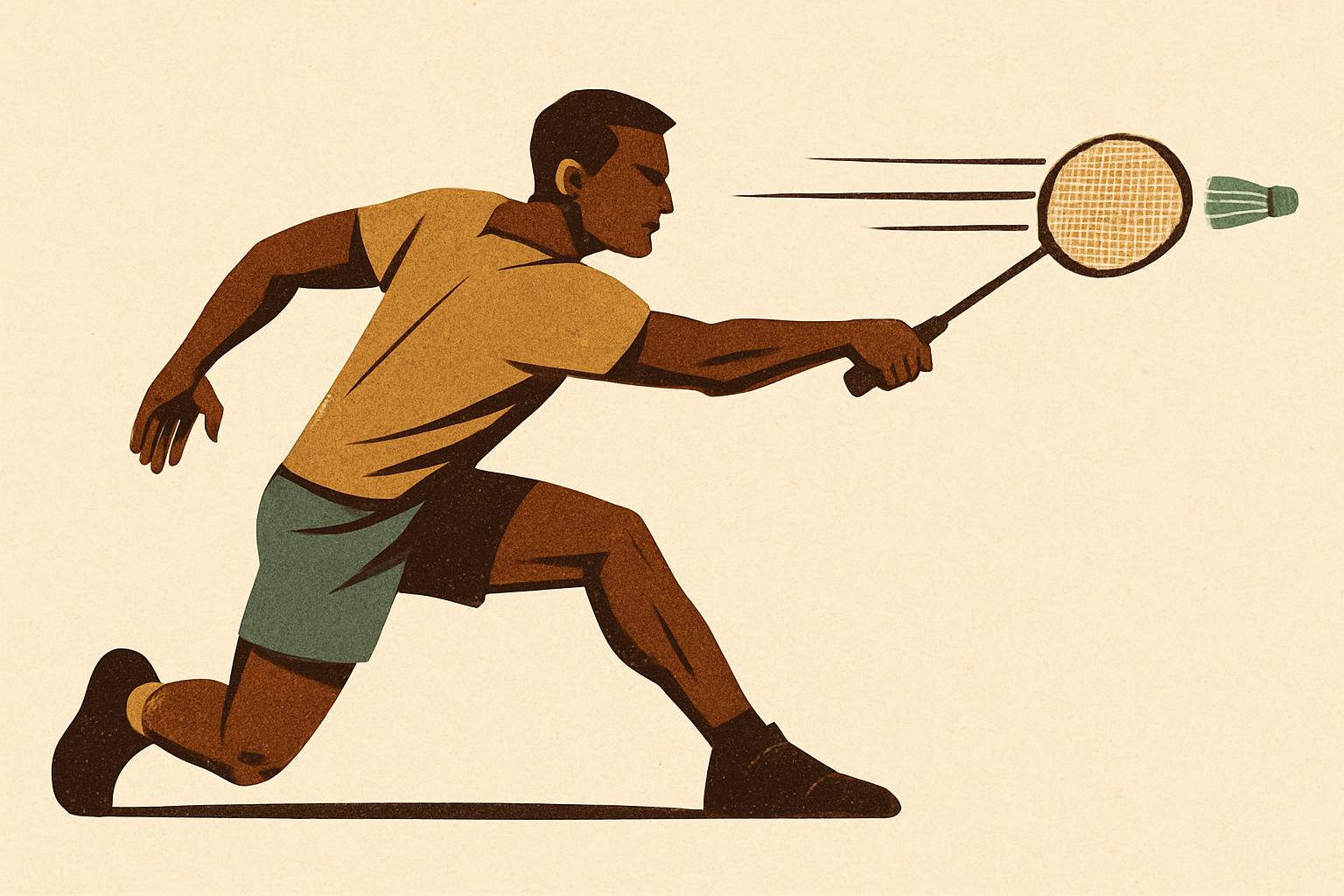
Between the net battle and the overhead exchange lives the flat game: drives traded at shoulder height across the midcourt, each player refusing to give the other a downward ball. It's the tempo core of modern doubles — and the fastest visible skill in badminton, where exchanges run four shots a second.
One thing to master: keep the drive FLAT. The first player whose drive floats up loses the exchange — height is surrender in the flat game.
What you'll learn
- Drive technique: compact swing, thumb grip, contact in front
- Forehand and backhand drives without grip panic
- The push drive: flat but soft, at their hip or the gap
- Winning the lift battle: making THEM hit up first
The technique
The technique
Sideways-on is a luxury the flat game doesn't allow: face the net, racket up, and strike with a short punch driven by forearm rotation and the thumb (backhand side) or fingers (forehand side). No backswing beyond your shoulder — the reply arrives too fast. Contact must be IN FRONT; late contact turns drives into floaters.
Keep it flat, keep it deep
The drive's job is to travel at net-tape height toward your opponent's rear midcourt. Anything that rises invites a kill; anything short sits up off the net. Drill flat height until it's your default trajectory.
The push variation
Same preparation, but the racket decelerates: a soft push that dies at their front-court hip or into the gap behind the net player (doubles). The push is to the drive what the drop is to the clear — the same disguise economy, at triple speed.
The refusal game
Flat exchanges end when someone lifts. Win by taking the shuttle EARLIER (crowding the tape steals reaction time from them, not you), angling drives into bodies and gaps, and mixing pushes so they can't camp on the fast reply. The player who blinks — who lifts first — hands over the smash.
Drills to practice
- Drive rallies: 30 consecutive flat exchanges with a partner, restarting if either shuttle rises above head height
- Body targeting: drives aimed alternately at your partner's racket hip and non-racket shoulder — they call which was harder to return
- Drive-drive-push patterns: two flat drives then a disguised push to the front; rotate roles every 10 sequences
Common mistakes
- Big tennis-style backswings — there is no time, and they telegraph everything
- Letting drives rise ('just getting it back' IS losing the flat game)
- Camping on the forehand and getting handcuffed at the backhand hip
References
- BWF Shuttle Time — official BWF teaching programme (technique modules) — shuttletime.bwfbadminton.com/
Rule statements in this lesson were validated against the BWF Laws of Badminton (Statutes Section 4.1, current edition) and BWF announcements. Technique and drill guidance follows the BWF Shuttle Time framework and widely taught club coaching practice.