Pickleball Tutorial Program · Advanced
Doubles Strategy & Patterns
This final lesson assembles everything into a playbook. Advanced doubles is played in patterns: serves with intent, returns with a plan, and pre-agreed answers to the common situations. None of it requires new technique — it requires the two of you deciding things BEFORE the ball is served.
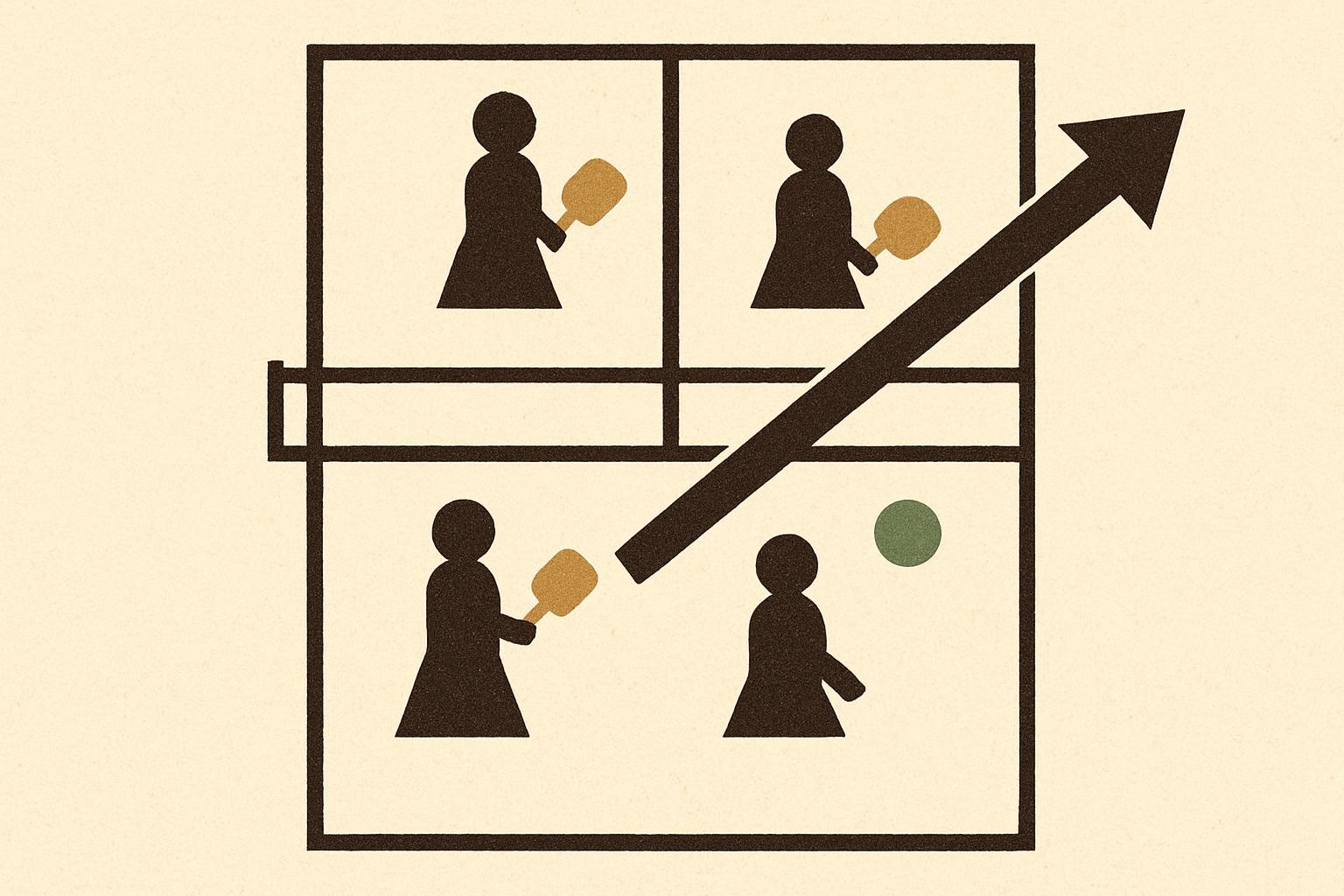
One thing to master: a shared plan for every serve and return — where each ball goes and who crashes. One pattern executed together beats five ideas held separately.
What you'll learn
- Stacking: what it is and when it pays
- Poaching and faking at the kitchen line
- Three bread-and-butter patterns to run tonight
- A communication vocabulary: mine, yours, bounce, switch, no
The technique
Stacking in brief
Stacking means both partners start on the same side so each plays their stronger court after the serve or return. Use it when one of you has a dominant forehand or you have a lefty. It costs movement — only stack when the benefit is obvious.
Poaching
At the line, the stronger volleyer cuts across the middle to intercept a predictable dink or block — ideally behind a signal or an agreed trigger ball. Even occasional poaching changes where opponents dare to hit; the fake poach is nearly as valuable as the real one.
Three patterns to run
1) Serve deep to the backhand → expect a middle return → drop and advance together. 2) Return deep to the weaker player → crash behind it → punch the first pop-up. 3) Drive the third at the body → partner crashes → finish the fifth (shake and bake, Lesson 12).
Talk on every ball
'Mine / yours' on middle balls. 'Bounce' on anything possibly out — deep balls near the baseline are out more often than beginners believe. 'Switch' on lobs. 'No!' when your partner winds up on a ball below the net. Quiet teams are guessing teams.
The advanced mindset
Attack down the middle, dink to the backhand, reset when pressured, speed up only above net height — and when in doubt, one more soft shot. That discipline, executed as a pair, is what 'advanced' actually means.
Drills to practice
- Play one full game stacked, win or lose — the movement pattern has to be automatic before it's useful
- Poach ladder: designate a poacher for 5 rallies; opponents score double if the poach gap is hit — teaches honest recovery
- Pattern nights: pick ONE of the three patterns and run it every rally for a game; review what broke down
Common mistakes
- Stacking everywhere because it looks pro, then losing points to the extra movement
- Poaching without recovery — the vacated lane is a highway if you miss
- Two individual game plans on one team
References
- USA Pickleball — 2026 Official Rulebook, Section 4 (service sequence — the legality that makes stacking work) and Section 9 — usapickleball.org/docs/rules/USAP-Official-Rulebook.pdf
- USA Pickleball — Official Rules hub (updated annually) — usapickleball.org/rules/
Rule statements in this lesson were validated against the 2026 USA Pickleball Official Rulebook (effective January 1, 2026). Technique and drill guidance reflects widely taught coaching practice for recreational play.